
Why desk work ends up here
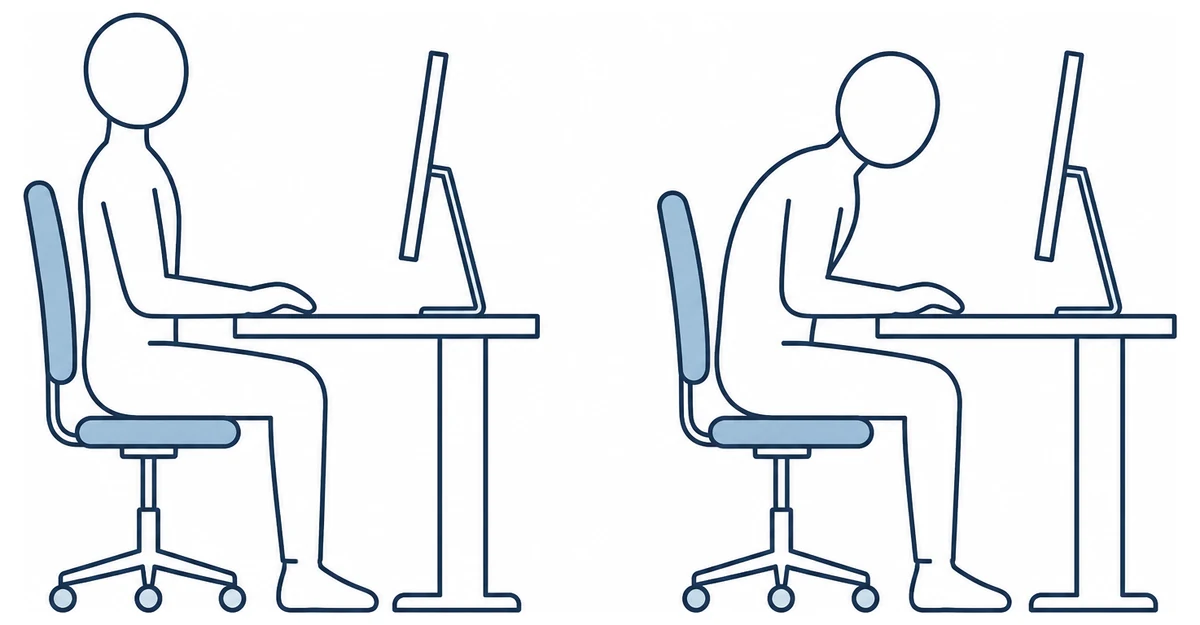
Many people who work at a desk spend eight or more hours a day with their head reaching toward the screen instead of stacked over their shoulders. That difference matters more than it sounds like it should. Every inch your head sits forward adds real weight your neck and upper back have to hold up, hour after hour. A laptop set below eye level, a phone held between your ear and shoulder, or a chair that lets your low back slump can all add to how much work your neck ends up doing just to hold that position.
People often try a new chair, a standing desk, or a stretch routine first, and those things can genuinely help for a while. The ache often comes back anyway, because the load pattern and the way the joints in your spine are moving have not changed, only the equipment underneath you did.
Over months and years, that pattern can show up as a shift in how the neck bones are lined up and moving. That is what we check for on your first visit: where it hurts, and just as much, where the joints in your neck and upper back have lost their normal motion or alignment.
What we hear from desk workers
- Neck stiffness that sets in by early afternoon and does not ease up by evening
- Headaches that start at the base of the skull and spread toward the temples
- Shoulders that end up near your ears by two or three in the afternoon
- Being told you have tech neck or forward head posture
- A knot between the shoulder blades that stretching never seems to touch
- Tried a new chair or a standing desk, and it only helped for a week or two
What we actually do about it
Dr. Chris uses the Gonstead method, which means the exam looks at your whole spine, not only the neck. Desk-related strain rarely stays in one place. The mid back rounds forward, the low back compensates to keep you balanced, and the neck usually ends up carrying the part you actually feel. On your first visit he checks your full spine, including how your head sits relative to your shoulders, and orders X-rays through a nearby imaging center so he can see the alignment directly instead of guessing from posture alone.
Patients are often adjusted that same first visit. The second visit is when you sit down together and go over what the X-rays and exam actually showed. That is the report of findings, and it is where a plan gets built around what he found.
Adjustments for this group are usually focused on the neck and the joints at the top of the back, aimed at restoring motion to segments that have gotten stuck from the same forward-reaching position held day after day. Dr. Chris will also typically talk through your monitor height, chair setup, and how often you are getting up, because the desk is still going to be there tomorrow. The goal over a course of care is to give your neck room to move the way it is supposed to, so the position you are stuck in for work does not have to cost you as much.
Questions people ask
- Will this get rid of my tech neck for good?
- No one can promise that, and we would be careful of anyone who does. What we can do is check your spine, including X-rays if needed, look for the joints that are not moving the way they should, and build a plan aimed at improving your alignment and how your neck functions day to day. How much changes, and how well it holds, depends on your case and on what happens at your desk the other six days a week.
- Do I need an X-ray?
- Usually yes, on the first visit. Dr. Chris refers X-rays out to a nearby imaging center so he can see how your spine is actually sitting instead of guessing from posture alone. Patients are often adjusted that same first visit, then come back for a second visit where he goes over what the X-rays and exam showed. That is the report of findings.
- Can this help with the numbness or tingling I get in my hand from typing?
- Sometimes the nerves involved trace back to the neck, and if that looks like what is happening with you, addressing the neck can be part of the picture. Hand and wrist symptoms can also come from somewhere other than the spine, so we will check your neck as part of the exam and tell you plainly if what you are describing looks like it needs a different kind of care.
- Do you take my insurance?
- This is a direct pay office, so we are not in network with any insurance plan. We do accept HSA and FSA cards. Pricing depends on what you need, so we go over it by phone before your visit, and your first visit comes with $50 off.